Jump on board as King Island Alaskan native Sean Gallagher challenges the Design Squad teams to build ten-foot kayaks using traditional design but with non-traditional materials.
- 1) The Challenge
- 1) The Challenge (4:27)
- 2) Brainstorm & Design (5:55)
- 3) Build (10:33)
- 4) Test (2:39)
- 5) Judging (4:01)
- 1) Fire (0:40)
- 2) Noah Visits (0:49)
- 3) Buoyancy (0:32)
- How do you build a traditional-style kayak using non-traditional materials? Each team must build a kayak that floats and allows the kayaker to paddle smoothly through a slalom course.
- Green team looks at a drawing of a traditional kayak and quickly decided to follow that plan, without brainstorming different ideas. They measure the PVC pipe and compare that to the measurements of a traditional kayak.
- Green team thinks about the shape of kayak. They want the kayak to be easy to ride without tipping over, so Jason suggests they make their kayak wider. He's on the right track. A kayak with a wide and flat-bottomed hull will be more stable.
- Green team puts together the pieces of PVC pipe by cutting "bird-mouth" joints. Then they use plastic zip-ties to tie the tubes together. Green team didn't cut their pieces very carefully which makes them difficult to join together. After they have all the pieces in place, they use shrink wrap to make the skin of their kayak. But when they are heating the shrink wrap, they accidentally burn a hole in the side of the kayak!
- Green Team's kayak floats, but its shape makes it difficult to paddle without tipping over. The client says that it needs to have a flatter bottom to make it more stable. They worked hard, but Green Team loses this challenge.
- How do you build a traditional-style kayak using non-traditional materials? Each team must build a kayak that floats and allows the kayaker to paddle smoothly through a slalom course.
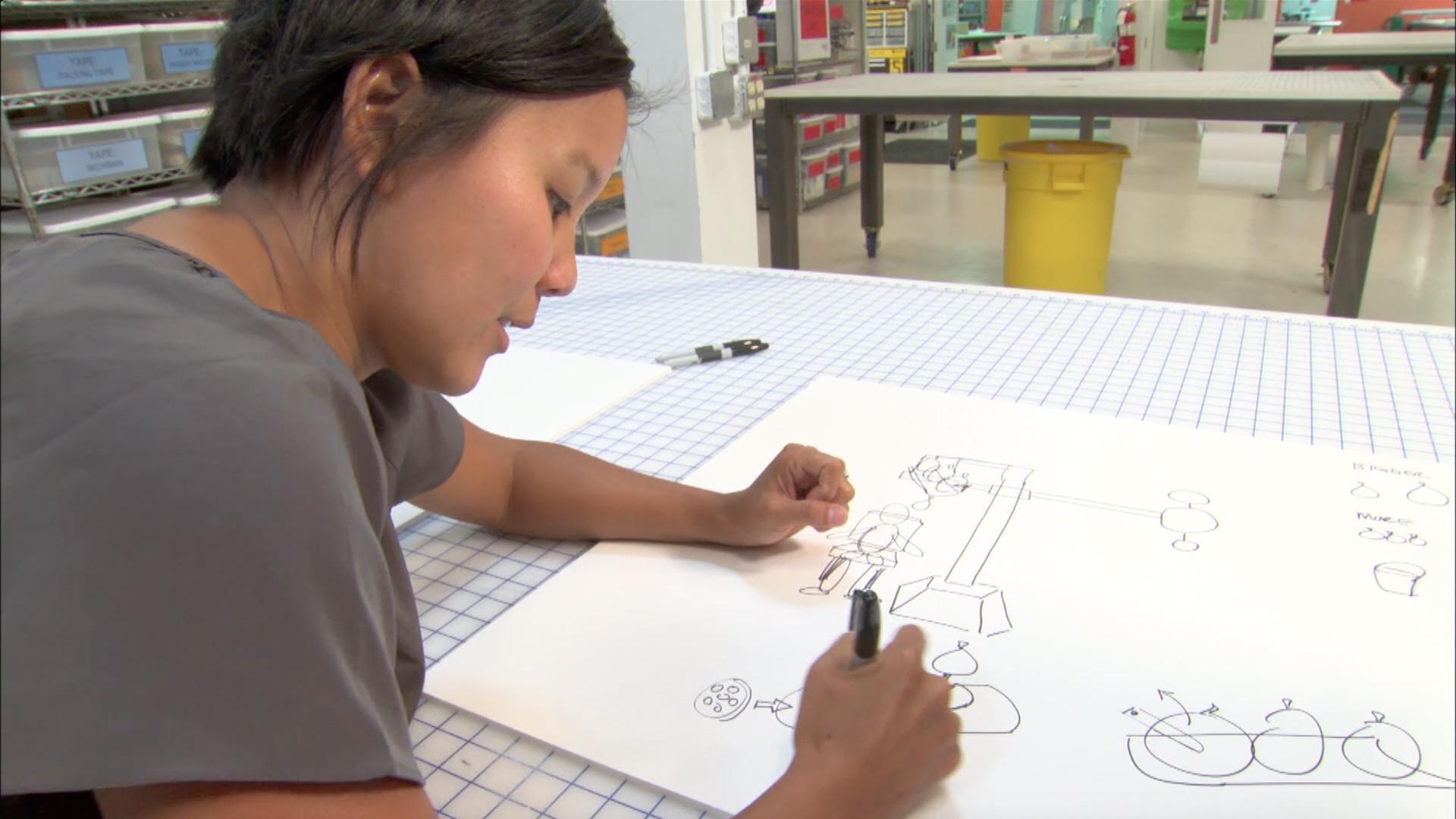
- Purple team starts the brainstorm by looking at all the different materials they have. Then they draw out a plan for how the pieces could fit together to make the kayak.
- Purple team begins to measure the pieces. They put the pieces of the kayak on the floor, and then have a person sit down beside them like they are actually in the kayak. They measure the pieces to fit the person and then carefully cut their plastic pieces. Both Purple and Green teams use the rim of a bicycle tire to make the opening on the top of the kayak. Finally, Purple Team uses zip-ties and glue to join the pieces together.
- Both teams use plastic "shrink-wrap" to make the skin of their kayaks. Plastic is made up of long, twisty molecules called "polymers." Shrink-wrap is a special plastic film that has been heated, stretched out and then cooled to make its polymers straight. When the purple team re-heats the shrink-wrap, the polymers relax back to their original shape, shrinking the wrap over the frame of the kayak.
- Purple Team's kayak floats on the water. It has a wider hull that keeps it from tipping over. It's easy to turn because of the bottom of the hull has a convex curve shape. Purple Team's kayak wins the challenge!
Connie Yang designs tents for NEMO Equipment. Watch this.
Design and build a boat out of straws and plastic wrap.