Recently in Design Category

Kinetic Architecture

user-pic
Hey DS Nation! Engineers are doing some amazing things in the world of architecture these days. Beyond creating beautiful designs, engineers are finding new ways to build structures that work more efficiently and are better for the environment, but the design we'll look at today is taking environmentally-positive engineering to a whole new level! 

This building will have 80 floors that will each rotate 360 degrees, meaning it will actually spin! The building will also have wind turbines built right into its sides, so that the strong wind surrounding the structure will spin the turbines, creating a free energy source for the people that live there. So cool! We engineers call this building kinetic, because it moves. 

Check out this video to see this amazing piece of kinetic engineering:

For our BUILD BIG Contest, we challenged you to take one of our activities and build the biggest, most awesome version of it you could. Meet three of our contest finalists: they took our confetti launcher activity and made it colossal! Because a BIG cloud of confetti is totally fun!!

The team wanted a challenge, so they decided to build a trebuchet launcher. A trebuchet is a kind of catapult that uses a counterweight to help launch things (like confetti). Trebuchets have been used in battles for hundreds of years.

Click on the video to see how the team brainstormed, built, tested, and perfected their Colossal Confetti Launcher.


Wow! That confetti launcher is totally party ready.

If you haven't made a confetti launcher yet, head over the Projects section to give it a try. Just click on the wish below.

confetti-wish.jpg


And be sure to check out the Contest page to see videos from our other finalists and the BIG winner, too.
ds-106-finalbike.jpg


I wasn't satisfied leaving the musical bike slightly unfinished, so after the block party I snuck back to The Crucible to finish up. First, I stained the whole bike with a nice oak varnish to give it a beautiful antique look. Then, I removed the stray pieces of tape on the bike and added screws to hold the bike together. Finally, I took a few hours and did a proper job of connecting the drivetrain so that the gears were nice and strong. The result was perfect! The bike pedaled smoothly, pumping the bellows, with the music blowing clearly out of its pipes. I couldn't be happier with the result. I can't wait to see what Beatriz, Rusty, and the folks at The Crucible have added to the bike the next time I visit -- flames?!
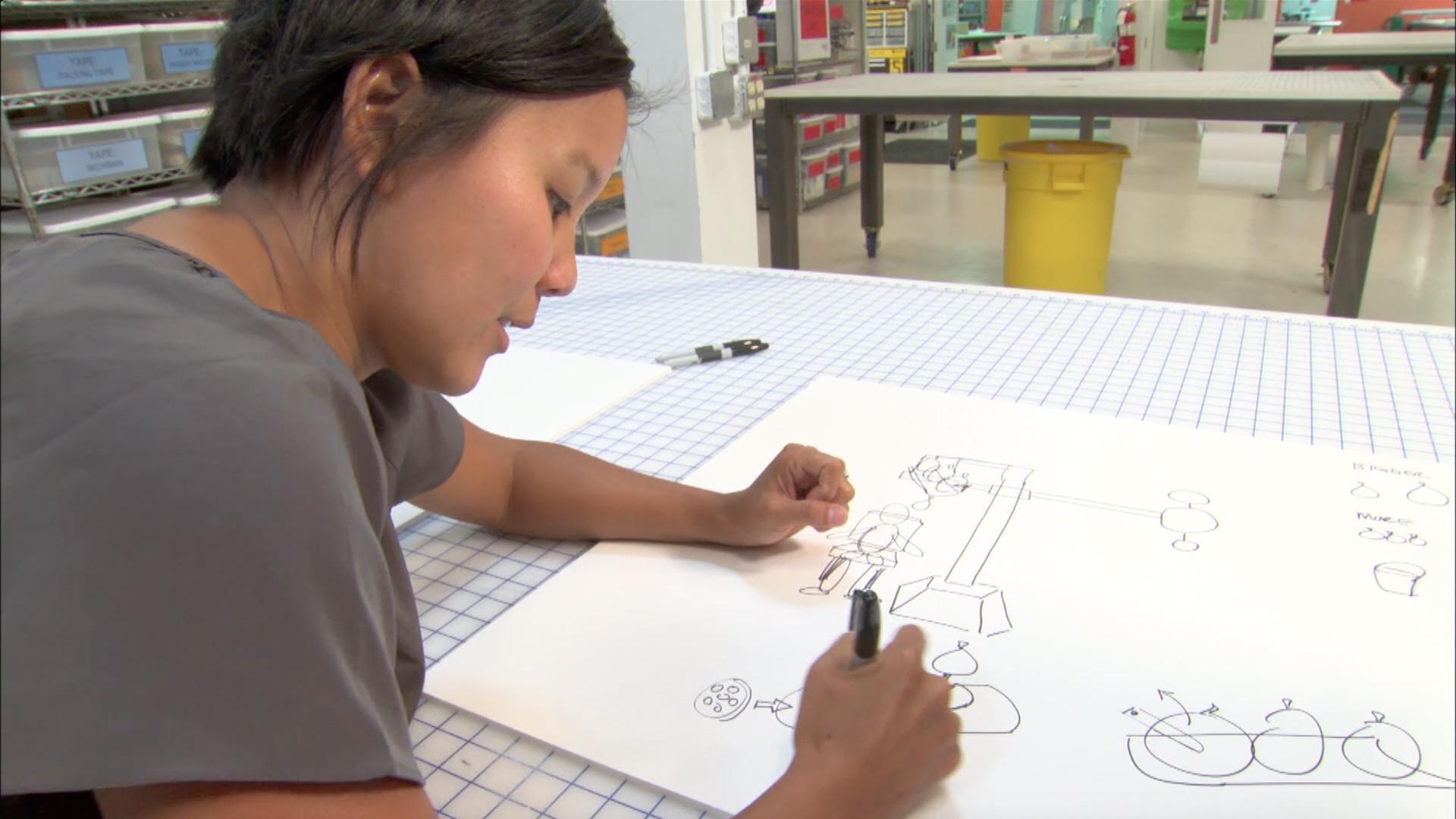
During our bike ride with Beatriz, we brainstormed ideas for the build.  Beatriz is all about music - in fact, she even planned a block party for the upcoming weekend where she and her jazz band are going to perform! It's the perfect occasion to unveil our build.  With music as our theme, we brainstormed how we could combine an instrument with a bike -- we came up with a pipe organ. We realized we could use the energy produced by pedaling the bike to pump up an air reservoir and generate sound from organ pipes mounted on the bike. It's a wild idea, and I'm pretty sure there's nothing like it out there! Just imagine, this thing rolling down the streets?! This is going to be a great build. Check out my initial sketch for the musical bike.

adam-bike-sketch.jpg


Adam's Glider Prototype

user-pic
Adam talks us through his process for building a prototype for his glider using balsa wood. Then he tests his prototype right in his house to observe how his glider design flies.


Want to see the final launch of the glider? Check out Part 2 of "One Giant Leap" below.

The World Cup is the greatest soccer exhibition on Earth, bringing the best players together to show their skills -- so it only makes sense that they would also use the best equipment, right? Every four years, engineers are brought together to design the official World Cup soccer ball. Textures, patterns, materials, durability -- all of these aspects of design are considered when creating the world's greatest soccer ball. Here is a video that describes the unique process taken by the engineers to develop the new product.


For more sports equipment design, check out this Design Squad Nation video about engineers using their skills to make baseball bats!


Wingsuits!

user-pic
Wingsuit flying is the sport of flying the human body through the air using a special jumpsuit, called a wingsuit, which adds surface area to the human body to create an increase in lift. Think about how a parachute spreads out to catch air in order to slow down a skydiver -- the Wingsuit works in a similar way, only smaller. Modern wingsuit designs increase surface area with fabric between the legs and under the arms. A wingsuit may be referred to as a birdman suit or squirrel suit.

Check out this video of some experts using the Wingsuits. [Remember, only experts should use the suits.]


In this overhead view of the Wingsuit, you can see the extra panels that catch air like a parachute to increase lift.

Wingsuit-01.jpg
The design of the Wingsuit can be traced back to Flying Squirrel. The Flying Squirrel doesn't actually fly -- it glides by using the loose folds of skin running down the sides of their bodies, just the the Wingsuits! Here is a video of the flying squirrel in action.


Motorized Sculpture!

user-pic
Recently on the Design Squad Nation Blog we looked a a building that featured independently rotating floors, creating a constantly-changing shape. The building became a piece of kinetic sculpture. In other words, it moved! 

Here is another example of kinetic sculpture that was created by using hundreds of small motors. By attaching different materials to the motors, the sculptures create unique sounds. When you watch the video, notice how the metal makes a different sound from the rubber. What material would you attach to the motor?


The EyeWriter

user-pic
tag.jpg

Design Squad Nation has always believed that an engineer's job is about making dreams come true through engineering. The EyeWriter project is a perfect example of this message.

EyeWriter is an ongoing collaborative research effort to empower people who are suffering from ALS with creative technologies. Specifically this project was started to help a graffiti artist named Temptone who was diagnosed with ALS in 2003, a disease which has left him almost completely physically paralyzed... except for his eyes. Unable to create his beautiful artwork using normal graffiti practices, the EyeWriter team wanted to come up a way for Temptone to continue to share his vision with the world. 

Taking advantage of his ability to move his eyes, the EyeWriter team developed a system that allows Temptone to actually draw by tracking his eye movement. Collaboration between Temptone and the Eyewriter team was essential to the success of this project. By understanding exactly how Temptone created his art, and what his new physical capabilities were, the engineers were able to create a stronger product. This process of designing for the user and their capabilities is called Human Factors Design. 

Check out this video of the design process behind EyeWriter.


To make this EyeWriter system work, Temptone uses these special glasses that track his eye movement. 

eyewriter-glasses.jpeg

And this is an example of the artwork that Temptone created using the EyeWriter system...

IMG_8367.jpeg

Geodesic Domes!

user-pic
Geodesic domes are a cool form of architectural structure that uses smaller, modular shapes to make a circular surface. For example, Spaceship Earth at Epcot Center in Disney World is what we call a geodesic sphere because it uses lots and lots of triangle shapes to make up the bigger globe shape. Here is a picture of it...

secret-life-logo.png
Design Squad Nation thinks geodesic domes are really cool! In fact, the winner of the Trash to Treasure 2008 Contest, Max, based his Home Dome design on this exact structure. Here is a video of Max building a full scale model of his Home Dome design at Continuum.


You can see in the video that Max's model was made up of pentagons and hexagons, just like the spinning orb below. This form allows his Home Dome design to be stronger and more easily manufactured. In other words, it makes it really quick and easy to produce lots of Home Domes.

Check out this animation to see all the sides of a geodesic sphere.

secret-life-logo.png